Ever since I found out I would be in Tokyo, I have planned to spend most of my weekends in Kamakura. Yet my glitzy new social life and the excitement of the city have kept me in the entertainment districts for nearly a month now. For a couple of weeks I resolved to go to Kamakura today, and by god, I did. And was very surprised to find it only took 45 minutes to get there. If it weren't for the expense (maybe $16 round-trip?), I would be there every day!
There are many things to see and do in Kamakura, but today was just about personal sanity--I had to get out of the city and do some hiking. So I had planned to just walk the Ten-en trail that winds around the hills above Kenchoji. But of course, Engakuji is right there at the Kita Kamakura station, so I couldn't help stopping there first.

The winter sun hangs low over Japan, so when I reached Kita Kamakura at 2pm, its gradual descent had already begun. Half of me felt edgy about being caught on the trails in the dark; The other half was delighted that everything is transformed by 'the golden hour,' and I happened to have 3.
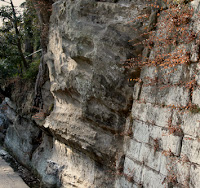
I wandered through Engakuji, simply experiencing the place. I didn't bother to identify the various buildings or their historical context--I left my inner-academician at home. The ume blossoms were lovely--Engakuji has many. Certain things from Dr. Harper's art history lectures did strike me, and it was very powerful, experiencing them in person: the indigenous Japanese layout--meandering, asymmetrical, intuitive; the easy mixture of decorative Chinese architecture and austere indigenous styles; the amazing little accidents of nature celebrated everywhere... I love the masonry that lines the walkways. It was a wonderful contrast to the reconstructed masonry I saw at the Imperial Palace on sunday. Those straight, solid walls communicated power and force, but at Engakuji, straight rows of square rock give way to random thrusts of twisting cliffside, and groping roots cling to every crack.
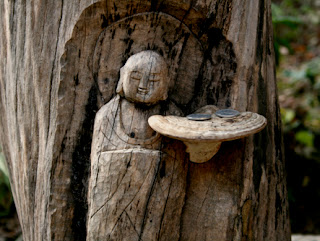 |
| Accidents of nature rock my socks off. And yes, that is a money mushroom. |
One of the highlights of Engakuji was a venerable old ume tree, bent over like an elderly rice-farmer, its trunk so cracked and broken as to appear hollow; it completely depended upon the supports that had been carefully constructed around it. However, at the end of this tortured trunk there bloomed a sparse crop of ume blossoms, lovely in their scarcity. That is the kind of tree Zenchiku described as the pinnacle of reticent beauty: "after enduring years of rain, dew, wind, and snow, [it] puts forth only a few scattered blossoms."


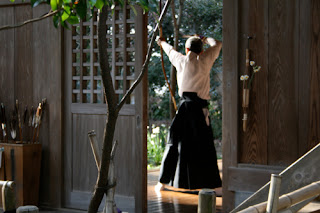
As I was leaving Engakuji, aware of the waning light, I noticed a group of people dressed in traditional Japanese clothing. I wandered toward the subtemple and found that they were practicing traditional archery. It was like dance: precise, slow, grueling, elegant... A man in his sixties raised his loaded bow above his head and slowly brought it down to his chest; even more slowly, he drew back the bowstring, his arm visibly shaking with the effort. When he finally loosed the arrow, it whizzed swiftly to the target. It was mesmerizing to watch. The golden light hit their white garments in just such a way... I so wanted to keep this image. It took a few minutes, but I psyched myself up to approach one of the instructors and ask if I could take a photograph. She smiled and said it was fine, so I took a few.
A cheerful middle-aged man was working the gift-shop counter. We bantered a little, and he told me about his visit to Los Angeles 20 years prior. Everyone in Kamakura was friendly. Tokyoites are amazingly friendly for city folk, but a small town like Kamakura can't be beaten.
After Engakuji, I walked past a little studio with a wall covered by postcards and prints of cats. The cats were rendered in various colorful pop-art styles. A little tabby--one of the models, I later learned--slunk away as I approached. A kind, joyful looking man was crouched out front, watering some potted plants. "Is this [uncle's] art?" I asked him. He smiled and nodded. I explained my course of study in Tokyo, and we struck up a fun conversation. He showed me one of the postcards that included all five of the cats depicted in his work. They all live there with him; he told me each of their names. They were all adorable, but I only remember three of them: Gohan (rice), Meron (melon), and Mikan (clementine/satsuma). I bought one of his postcards and got his meishi (business card). I'm gonna post a link to his website, however, a lot of the art I saw at his shop is much better than the stuff he has uploaded here:
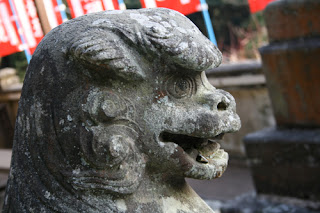
I walked past a Murasaki Imo Sofuto stand--they sell Kamakura's famed purple potato ice cream (!)--but I was short on change and decided to save that experience for later. Then I entered Kenchoji. I ended up cutting through most of it, though I did enjoy a glance at the architecture, and on my way back down, I heard an evening service being chanted, which was lovely. I made my way up several flights of stairs to the highest point in the complex; high-school baseball players sprinted past me, panting and groaning. Lions and strange bird-faced guardians grimaced at all newcomers. In front of the highest sub-temple sits an observation deck, and there I found the baseball boys convalescing on benches. I was awed when I looked back and saw the whole of Kamakura laid out before me, and the ocean beyond. Oddly, It was my first time seeing the water since my flight into Narita, though I live about 30 minutes (walking-distance) from the bay.
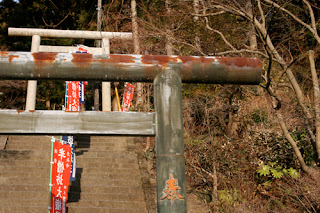
That's where the trail began-- the Ten-en 'Haikingu Kosu' (Hiking Course ^_^)--and it went straight upward--another two flights of stairs, and an even better observation deck. I could see about forty-five minutes between the sun and the sea, so I picked up my pace. From there the trail was often flat, though sometimes I had to scale surprisingly steep rocks with both hands. One particularly precipitous passage had a helpful knotted rope attached to it.
The terrifying part? Several people passed me as I panted asthmatic, with a calm and composed 'konnichiwa!' ...and most of them were at least 60 years old. I had actually read about this curious phenomenon-- the septuagenarian domination of the sport of hiking in Japan. Apparently it is unique among the world's countries: few nations have such active seniors. Still, nothing can prepare you for the mortifying moment when someone more than three times your age leaves you in the dust.
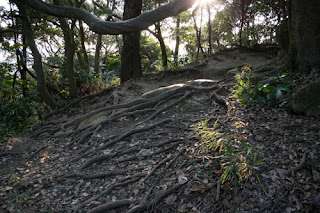
The trails were lovely. At first I found myself in a tunnel of dense bamboo, but after that it was standard forest, golden light streaming through bare deciduous branches. Among their snaky roots were nestled dozens of caves and niches, some of them a foot tall, some of them big enough to walk into. Many of these hosted little buddhas, bodhisattvas, and images of teachers. Spent incense sticks stood in little glass cups at their feet. One magnificent near-life-size statue of a teacher sat serenely at the top of a steep rock formation, framed by fluttering white prayer flags. Ancient kanji carved in the cliffside had become nearly illegible with age.

Periodically I would reach a small clearing, and once again Kamakura--clear to the sea--lay golden before me. The camaraderie of hikers is even greater than that of morning people--everyone I passed greeted me with a hearty 'konnichiwa!' Broad, dark hawks swooped overhead, crying out into the evening, and occasionally I'd be startled by the ominous and sudden WARRA! of a crow overhead.
Elated by my surroundings, I clearly saw what the theme of the entire day had been-- a recurring thought: this is the Japan I came to see. This is the Japan I was looking for. For the past few weeks, I've dressed well and made an effort to be very outgoing. I've even gone out on the town and partied (a little). Free to try on a new identity, and without any intense academic workload to tether me to my old one, I definitely experimented. But today as I was hiking, it suddenly seemed very clear: I have flirted with Shinjuku, Shibuya, and Minato--clothes, makeup, and getting phone numbers from random (but charming!) Japanese college boys. But days like the one I had today in Kamakura--they're the reason I'm here, and I won't let go of that.
Little did I know that the high-points of my day had yet to come. When I reluctantly doubled back to the observation deck at the trail head, the sun was finally about to touch the sea. It hovered in the haze like a giant, bright, pink-gold peach. Below it the sea glowed, a flat strip of light. It was like living and breathing inside an 18th-century gold-leaf byobu. The orange of the sky was fading, and a light blue mist hung over the city below.
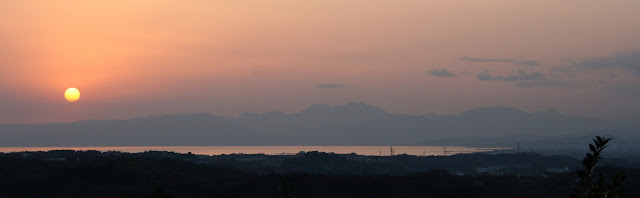 |
| Sunsets are hard to capture, but I tried. Basically, it was like this except cooler. |
An old man walked up beside me. He grinned and asked me where I was from. I told him, and he made a gesture like he'd been hit by a truck ("Uwa!"). From then on I was drawn into a wonderfully animated conversation with this eccentric ojiisan, which lasted the entire walk back to Kita-Kamakura station. I guess another one of those universals is elderly people thrilled to spend a few minutes not being ignored. In any case, he spoke slowly and clearly (or 'normally and comprehensibly' to my ear, but I guess that's why I'm a gaijin) and so we sustained a shockingly fluent conversation.
It was wonderful practice. Maybe I was on a roll, or maybe I just knew he'd be patient with me so I was less flustered, but I must have used every grammatical construction I've learned over the past 3 semesters. We talked about all sorts of things. He told me he was out walking for his health, because he has diabetes. He also told me about a trip he once took to San Francisco, and about seeing the Golden Gate Bridge. He laughed when I told him that in LA, a distance that takes 30 minutes by car requires 2 hours by bus ("Don't you have trains there?"). He even asked me if LA was scary (making a pantomime of a handgun--he's the second person here to associate LA with such a gesture). We talked about various Japanese foods I have yet to try--he was surprised to learn that I, [gaijin], 'can' eat sushi ("taberaremasuka?! Uwa!"). But he also seemed surprised that I had never eaten eel. Go figure. He also told me he actually doesn't like Murasaki Imo Sofuto, though he's lived in Kamakura his whole life.
He was curious to know what Americans think of Japanese culture. It was hard for me to describe in broad strokes, so I decided to focus on a positive specific: how American kids love Japanese anime. He thought this was pretty amusing. It led to a detailed conversation about our favorite Miyazaki movies (yes, even Ojiisan loves Miyazaki!), which led to the shocking revelation that I am actually familiar with some of the iconic Japanese films that came out when he was my age ("Mizoguchi wo shteiru?! Ozumo?!!"). That was a wonderful affirmation. It's actually the first time I've talked about movies with a Japanese person old enough to recognize my favorite art films from the 50s and 60s.
When I reached the train station we went our separate ways, but I sure hope I run into him again--after all, Kamakura's a small place.
Here are some more pictures of Engakuji:


 The winter sun hangs low over Japan, so when I reached Kita Kamakura at 2pm, its gradual descent had already begun. Half of me felt edgy about being caught on the trails in the dark; The other half was delighted that everything is transformed by 'the golden hour,' and I happened to have 3.


