Saturday, January 29, 2011

Engrish Report III

 A handbag:

"On The Rord Again"

I think they should make a song out of it.

On a large shopping bag:

"You gave all these gentleness of me and strength
STRONG CHILD TREASURE
CUTE KID GOOD CHILD
your word is like magic.
GENTLE CHILD
SPLEASE PRAISE ME."

Needless to say, the 'splease' is sic.

On a haute coutoure ad:

"Lingerie is Love-Jewelry"

I'm not even sure what to do with that one...

A type of candy:

"Crunky Ball Nude"

Ironically, they kind of look like gonads.

2 gems from the pizzeria where I ate in Shinjuku last weekend:

"sake is the best of all"

and, the HOLY GRAIL of all engrish:

a poster of a frog in a glass that says:

"ENGRAND"

That's where I'm going on my next vacation.

And oh @#$% a @#$%ing KAPPA!

Note from the Blogger

Pictures are really difficult to format on this blog. For some reason I'm really picky about that. So it bugs me.

AND NOW YOU KNOW. (+_+)

Escape to Kamakura


Ever since I found out I would be in Tokyo, I have planned to spend most of my weekends in Kamakura. Yet my glitzy new social life and the excitement of the city have kept me in the entertainment districts for nearly a month now. For a couple of weeks I resolved to go to Kamakura today, and by god, I did. And was very surprised to find it only took 45 minutes to get there. If it weren't for the expense (maybe $16 round-trip?), I would be there every day! 
There are many things to see and do in Kamakura, but today was just about personal sanity--I had to get out of the city and do some hiking. So I had planned to just walk the Ten-en trail that winds around the hills above Kenchoji. But of course, Engakuji is right there at the Kita Kamakura station, so I couldn't help stopping there first. 


The winter sun hangs low over Japan, so when I reached Kita Kamakura at 2pm, its gradual descent had already begun. Half of me felt edgy about being caught on the trails in the dark; The other half was delighted that everything is transformed by 'the golden hour,' and I happened to have 3.

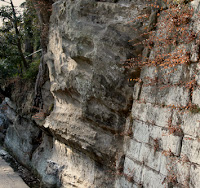
I wandered through Engakuji, simply experiencing the place. I didn't bother to identify the various buildings or their historical context--I left my inner-academician at home. The ume blossoms were lovely--Engakuji has many. Certain things from Dr. Harper's art history lectures did strike me, and it was very powerful, experiencing them in person: the indigenous Japanese layout--meandering, asymmetrical, intuitive; the easy mixture of decorative Chinese architecture and austere indigenous styles; the amazing little accidents of nature celebrated everywhere... I love the masonry that lines the walkways. It was a wonderful contrast to the reconstructed masonry I saw at the Imperial Palace on sunday. Those straight, solid walls communicated power and force, but at Engakuji, straight rows of square rock give way to random thrusts of twisting cliffside, and groping roots cling to every crack.

Accidents of nature rock my socks off. And yes, that is a money mushroom.
One of the highlights of Engakuji was a venerable old ume tree, bent over like an elderly rice-farmer, its trunk so cracked and broken as to appear hollow; it completely depended upon the supports that had been carefully constructed around it. However, at the end of this tortured trunk there bloomed a sparse crop of ume blossoms, lovely in their scarcity. That is the kind of tree Zenchiku described as the pinnacle of reticent beauty: "after enduring years of rain, dew, wind, and snow, [it] puts forth only a few scattered blossoms."


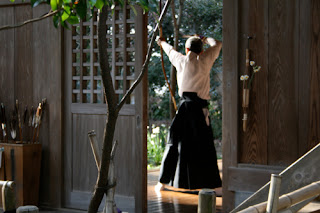
As I was leaving Engakuji, aware of the waning light, I noticed a group of people dressed in traditional Japanese clothing. I wandered toward the subtemple and found that they were practicing traditional archery. It was like dance: precise, slow, grueling, elegant... A man in his sixties raised his loaded bow above his head and slowly brought it down to his chest; even more slowly, he drew back the bowstring, his arm visibly shaking with the effort. When he finally loosed the arrow, it whizzed swiftly to the target. It was mesmerizing to watch. The golden light hit their white garments in just such a way... I so wanted to keep this image. It took a few minutes, but I psyched myself up to approach one of the instructors and ask if I could take a photograph. She smiled and said it was fine, so I took a few.


A cheerful middle-aged man was working the gift-shop counter. We bantered a little, and he told me about his visit to Los Angeles 20 years prior. Everyone in Kamakura was friendly. Tokyoites are amazingly friendly for city folk, but a small town like Kamakura can't be beaten.

 After Engakuji, I walked past a little studio with a wall covered by postcards and prints of cats. The cats were rendered in various colorful pop-art styles. A little tabby--one of the models, I later learned--slunk away as I approached. A kind, joyful looking man was crouched out front, watering some potted plants. "Is this [uncle's] art?" I asked him. He smiled and nodded. I explained my course of study in Tokyo, and we struck up a fun conversation. He showed me one of the postcards that included all five of the cats depicted in his work. They all live there with him; he told me each of their names. They were all adorable, but I only remember three of them: Gohan (rice), Meron (melon), and Mikan (clementine/satsuma). I bought one of his postcards and got his meishi (business card). I'm gonna post a link to his website, however, a lot of the art I saw at his shop is much better than the stuff he has uploaded here:


I walked past a Murasaki Imo Sofuto stand--they sell Kamakura's famed purple potato ice cream (!)--but I was short on change and decided to save that experience for later. Then I entered Kenchoji. I ended up cutting through most of it, though I did enjoy a glance at the architecture, and on my way back down, I heard an evening service being chanted, which was lovely. I made my way up several flights of stairs to the highest point in the complex; high-school baseball players sprinted past me, panting and groaning. Lions and strange bird-faced guardians grimaced at all newcomers. In front of the highest sub-temple sits an observation deck, and there I found the baseball boys convalescing on benches. I was awed when I looked back and saw the whole of Kamakura laid out before me, and the ocean beyond. Oddly, It was my first time seeing the water since my flight into Narita, though I live about 30 minutes (walking-distance) from the bay.
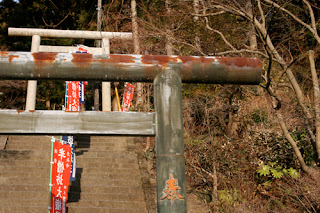
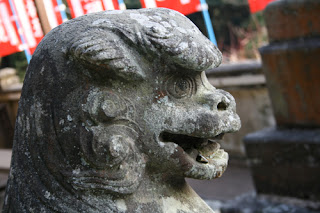


That's where the trail began-- the Ten-en 'Haikingu Kosu' (Hiking Course ^_^)--and it went straight upward--another two flights of stairs, and an even better observation deck. I could see about forty-five minutes between the sun and the sea, so I picked up my pace. From there the trail was often flat, though sometimes I had to scale surprisingly steep rocks with both hands. One particularly precipitous passage had a helpful knotted rope attached to it.


The terrifying part? Several people passed me as I panted asthmatic, with a calm and composed 'konnichiwa!' ...and most of them were at least 60 years old. I had actually read about this curious phenomenon-- the septuagenarian domination of the sport of hiking in Japan. Apparently it is unique among the world's countries: few nations have such active seniors. Still, nothing can prepare you for the mortifying moment when someone more than three times your age leaves you in the dust.
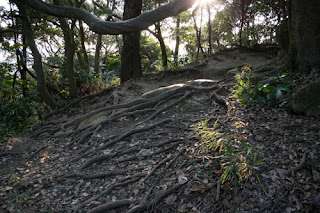

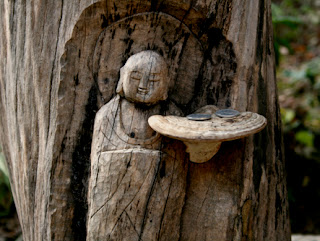
The trails were lovely. At first I found myself in a tunnel of dense bamboo, but after that it was standard forest, golden light streaming through bare deciduous branches. Among their snaky roots were nestled dozens of caves and niches, some of them a foot tall, some of them big enough to walk into. Many of these hosted little buddhas, bodhisattvas, and images of teachers. Spent incense sticks stood in little glass cups at their feet. One magnificent near-life-size statue of a teacher sat serenely at the top of a steep rock formation, framed by fluttering white prayer flags. Ancient kanji carved in the cliffside had become nearly illegible with age.


Periodically I would reach a small clearing, and once again Kamakura--clear to the sea--lay golden before me. The camaraderie of hikers is even greater than that of morning people--everyone I passed greeted me with a hearty 'konnichiwa!' Broad, dark hawks swooped overhead, crying out into the evening, and occasionally I'd be startled by the ominous and sudden WARRA! of a crow overhead.

Elated by my surroundings, I clearly saw what the theme of the entire day had been-- a recurring thought: this is the Japan I came to see. This is the Japan I was looking for. For the past few weeks, I've dressed well and made an effort to be very outgoing. I've even gone out on the town and partied (a little). Free to try on a new identity, and without any intense academic workload to tether me to my old one, I definitely experimented. But today as I was hiking, it suddenly seemed very clear: I have flirted with Shinjuku, Shibuya, and Minato--clothes, makeup, and getting phone numbers from random (but charming!) Japanese college boys. But days like the one I had today in Kamakura--they're the reason I'm here, and I won't let go of that.

Little did I know that the high-points of my day had yet to come. When I reluctantly doubled back to the observation deck at the trail head, the sun was finally about to touch the sea. It hovered in the haze like a giant, bright, pink-gold peach. Below it the sea glowed, a flat strip of light. It was like living and breathing inside an 18th-century gold-leaf byobu. The orange of the sky was fading, and a light blue mist hung over the city below.
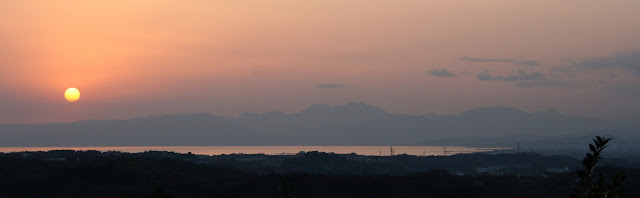
Sunsets are hard to capture, but I tried. Basically, it was like this except cooler.

An old man walked up beside me. He grinned and asked me where I was from. I told him, and he made a gesture like he'd been hit by a truck ("Uwa!"). From then on I was drawn into a wonderfully animated conversation with this eccentric ojiisan, which lasted the entire walk back to Kita-Kamakura station. I guess another one of those universals is elderly people thrilled to spend a few minutes not being ignored. In any case, he spoke slowly and clearly (or 'normally and comprehensibly' to my ear, but I guess that's why I'm a gaijin) and so we sustained a shockingly fluent conversation.

It was wonderful practice. Maybe I was on a roll, or maybe I just knew he'd be patient with me so I was less flustered, but I must have used every grammatical construction I've learned over the past 3 semesters. We talked about all sorts of things. He told me he was out walking for his health, because he has diabetes. He also told me about a trip he once took to San Francisco, and about seeing the Golden Gate Bridge. He laughed when I told him that in LA, a distance that takes 30 minutes by car requires 2 hours by bus ("Don't you have trains there?"). He even asked me if LA was scary (making a pantomime of a handgun--he's the second person here to associate LA with such a gesture). We talked about various Japanese foods I have yet to try--he was surprised to learn that I, [gaijin], 'can' eat sushi ("taberaremasuka?! Uwa!"). But he also seemed surprised that I had never eaten eel. Go figure. He also told me he actually doesn't like Murasaki Imo Sofuto, though he's lived in Kamakura his whole life.

He was curious to know what Americans think of Japanese culture. It was hard for me to describe in broad strokes, so I decided to focus on a positive specific: how American kids love Japanese anime. He thought this was pretty amusing. It led to a detailed conversation about our favorite Miyazaki movies (yes, even Ojiisan loves Miyazaki!), which led to the shocking revelation that I am actually familiar with some of the iconic Japanese films that came out when he was my age ("Mizoguchi wo shteiru?! Ozumo?!!"). That was a wonderful affirmation. It's actually the first time I've talked about movies with a Japanese person old enough to recognize my favorite art films from the 50s and 60s.

When I reached the train station we went our separate ways, but I sure hope I run into him again--after all, Kamakura's a small place.

Here are some more pictures of Engakuji:


Tuesday, January 25, 2011

Engrish Report II


A loofa with a suggestive silhouette scrubbing herself (suggestively):

"It enjoys the girl at sweet time"

I also walked past an old dude (60's?) wearing a white hoodie (street cred in itself--esp. in Japan) with these words written in rainbow letters on the back:

"I will try hard if you will allow me a short vacation."

I should probably explain the hilarity of this injoke: in japan, when someone is intimidated by an endeavor or even just happens to be doing something difficult you say "gambatte!" The literal translation is, "try hard!" Teachers and superiors will also often say this to students/employees. When a professor hands you a test, this is what they say. So in Japanese terms, this old dude is stickin' it to The Man. Hat-tipping is necessary.

Friday, January 21, 2011

Engrish Report I

Two gems from the cover of my composition notebook (which I bought, 3 for a dollar, at a hyakuen shop):

"It is our hope that this item will become your good friend and help to make your life enjoyable all the time."

I thought this was a pretty generous expectation for 30 cents. But the copywriter covered his/her tracks:

"The benefit of this notebook is up to the sense that comes from your passion."

... so I suppose my passion will dictate the bounds of our friendship. As of right now? I wouldn't call us 'passionate' quite yet, but my notebooks and I have a decent working relationship. And at the moment my life is enjoyable, nearly all the time. So maybe there's something to it. (^_-)

Another good T-shirt:

"Come back, apple!" (surrounded by bouncing apple motif)

Sunday, January 16, 2011

Second Sunday


As soon as I woke up today, I slopped together some clothing, ran a brush through my hair, and hurried out into the cold morning air. It was all in the name of journalism: I wanted to photograph my neighborhood in the gentle morning light. However I do enjoy being out and about on quiet mornings. And quiet it was. Japan may be a driven, performance-oriented place, but not at 7am on a Sunday. I shivered my way down the street, snapping furtive photos of interesting buildings, trying to capture the flavor of the place for my readers. 


It is a nice neighborhood, though it is an odd alternation between packed, grubby apartment buildings and shiny ‘five-star’ living. Literally, there is the “Five Star Takanawa” apartment just down the street. There are also some modest houses. The roads are narrow and petite, like so many in Tokyo. Sprawling 3-laned boulevards and expressways make up the skeleton of the city, but these little winding byways fan across Tokyo like veins.

Our apartment building (below right) is one of the grubbier buildings, but it isn’t packed tight like some of the others. It almost seems as if it’s been grandfathered in, because it sits opposite an exclusive gated community (I’m not even kidding--we see chauffeured cars roll past sometimes). There’s one magnificent tree next to our building (see below right). As my roommate Aki put it, one tree can make a big difference. Crows roost in it often. But mostly it’s just a nice chunk of green.

We’re also right next to a temple with a graveyard. It occurred that maybe that’s why they put such an affordable gaijin house here! Japanese culture is notoriously superstitious about ghosts, and the rest of the graveyard is bordered by parking lots and little bits of trees. However, I've noticed a lot of little cemetaries crammed in between houses throughout the city. It's quite different.

The apartment itself has ‘a touch of mange about it,’ but it’s quite comfortable. I am even a little cautious about calling it Spartan, because this is apparently luxurious living for a Tokyo daigakusei (college student). It even has more amenities (and a little more space?) than my L.A. digs. It’s wonderfully quiet too--nearly as quiet as my Westchester place. It would be, if it weren’t for the law school boys downstairs. At least they’re kind of entertaining: you should see their risible attempts to hook me up with one of their shy roommates. ^_^

A middle-aged Londoner lives across the hall from us. His name’s Tony Tapper (which sounds amazing in his accent--positively Dickensian) and he’s quite kind. On my very first day here, my roommate wasn’t home, and he drew me an elaborate map to make sure I got to the housing office in Shinjuku so I could get my key.


The indefinable camaraderie of ‘morning people’ is apparently universal. When I reached the charming little neighborhood park (above), it was nearly empty. A small coterie of older men were huddled around a bench a little ways off; surely village regulars. I wandered into the park, eyeing my prize: a blooming tree, one of the hearty few at this time of year. It is lovely. I couldn’t really capture it in photos, but I tried. Half of the tree was bare, but for a few crinkly red leaves still clinging to the slender branches. The other half had a sprinkling of lovely little white blossoms, and the branches were filled with little buds.


A kindly old man saw me admiring the blossoms, and we had a brief exchange in simple Japanese. He told me they were “ueno hana ume”--I didn’t recognize the word ‘ueno’ as anything other than a place name (see ‘Ueno Park’ entry ^_^), but according to an online dictionary, it can mean ‘first.’ I did know that ‘hana’ means flower and ‘ume’ is a type of Asian apricot. Indeed, umeboshi, pickled apricots, are a delicious traditional food that happens to be sitting in my fridge right now. So I responded, “Ah, like umeboshi!” Which made him smile. He pointed out another tree in the park, a sakura (cherry blossom). We agreed that we were looking forward to April. We commented on how early and pretty the blossoms were, but then we both got really cold (the old man gestured to his ears, but for me it was my fingers that were about to fall off) so we parted ways.

Most of my readers are probably aware of the prominence of the sakura in Japanese culture; come April, a third of the trees in the city will erupt with little pink blossoms, and hanami will begin. Hanami is the 1000-year-old tradition of ‘flower-viewing.’ There are many flower festivals across Japan, throughout the year--festivals to celebrate plums, peaches, chrysanthemums, and many others. But the sakura hanami is a universal phenomenon. Every year ther’s a ‘flower-watch’ on the national news, meteorologists and botanists diligently tracking and forecasting the spread of the blooms. So what does one do at a hanami party? Well, first one sets out a lovely picnic blanket; then one unpacks some elegant, healthy and delicious bento… and then you get falling-down drunk. Apparently, Hanami is really just an extra-classy excuse to get plastered by 10am. It’s like this, except outside:


To be frank… I can’t wait! I’m gonna bang on my rice-bowl with my chopsticks and it’ll be awesome. [NB: Japan’s drinking culture is the single fact that can explain the phenomenon of karaoke. According to many, many jidaigeki this nerd has seen, musical drunkenness is a revered tradition]

Anyway, I love little conversations like the one I had in the park--it’s my favorite thing about Tokyo. For such a big city, people really are very friendly and obliging. You’re expected to follow certain codes of behavior, and share certain values, which seem pretty homogenized from my background. But shared values and predictable behavior become a sort of social lubricant--there’s a sort of trust that becomes possible. Well, the extremely strict laws and enforcement also add to that. I see children, even in the nicer neighborhoods, walking or biking around by themselves.

For all who are curious, here are a few more photos of my neighborhood and my apt:


This is a totally shibui house down the street from us--it's completely covered in vines.
This is the entrance we use.

Our kitchen. Check out all the counter space. ^_^
The toaster oven on top is my new best friend. I put meat and veggies in tin foil, stick em in there, and that's how I eat.

This is the half of my room that isn't bed...
... and this is the half that is.
State-of-the-art desk.
Elegant boudoir. [note the hanger-holder--a clever dollar-store gadget]


That's the tour, folks.

I'll tell you about my scandalous weekend adventures when I've finished my homework [i.e., next month].  ^_^

Friday, January 14, 2011

Light-High and Fancy Free: Shinjuku

My head's still spinning from my first Friday night. Mild-mannered Arigato-san just had a 'wild' time out on the town!

My roommate and I made our second foray into Shinjuku's night-time scene. Fortified by the company of a trusted guy friend, we spent hours wandering those dazzling colonnades of neon color. We simply observed and explored.

Our first stop was a major department store, OIOI. Each floor of this colossus caters to a different 'scene,' or set of fantasies-- in fact, I am fairly certain that each of the floors hosted a handful of haute designers' specific boutiques. It was a spectacle, and we freely let our imaginations meander through the strange, winding backways of fashionably constructed identity. On the Lolita floor, we braved a frilly jungle of bustles, lace, and fur. One floor was filled with Japanese skater clothes: the kitschy love-child of Run DMC and Tony Hawk. But my favorite was the quasi-Edwardian fashion; prim but classically flattering clothing with (more than) a hint of 1890s daydream. Think long (but well-tailored) skirts with laced-up boots; sexy bodices over modest blouses; a top-hat here and a little lace there, but nothing too sensational. Mostly earth-tones. Basically, I think I'd feel like a witty Edith Wharton character in those clothes. They're wonderful.

I also felt a regrettable weakness for the modified-schoolgirl look that defined one of the boutiques. I just have a thing for tiered skirts and plaid. But hey, all my life I went to private schools with dress codes. Go figure. My roommate was most enthusiastic about the visual kei stuff (punk meets glam?). It's not my scene, but I liked one collection called "Alice and the Pirates." That is literally Alice of Lewis Caroll, encountering Pirates of the Caribbean (?). Japanese pop culture has a strange love for Alice: I intend to cover that in my forthcoming 'Japanamazing' page.

Then we met five or six guys from the Waseda University Tennis team. We needed directions in order to find Golden Gai, a famous, eccentric bar district. By this time I had some experience accosting random strangers for directions. In the company of my (picky but shy) roommate, I was accustomed to singling out attractive young men for said directions. And so, in my usual, caution-to-the-wind manner, I threw myself at a group of young men who happened past, shouting an earnest "Sumimasen!" They were well-dressed, and several of them were quite good-looking.

We described to them the specific gothloli bar we were trying to find. It's called Sumire no Tenmado, or something thereabouts... My guidebook said it is Tim Burton's favorite place in Tokyo, and a truly surreal experience. The boys were amused by our interest in a 'Gosu-rouri kissa' (kissa = cafe). Fortunately, they all spoke very good english, and several of them had iphones. They tried to direct us, but we were kind of confused. So they said, "well, why not?" and decided to take us there themselves. From the start they were jaunty and fun, and clearly very charmed by their new gaijin acquaintances. They were enthusiastic about my hometown, L.A. "Eiru Ei! Eiru Ei!" hooted one of the rowdier ones. They had that cocky joviality peculiar to athletes of any stripe. It was endearing. Because there were so many of them, each of us had at least two or three guys to chat with as we walked. We laughed a lot and connected over all sorts of odd things. One of the boys asked me if it snows in L.A., and I tried to explain that it's a desert, but they don't have deserts in Japan. I thought maybe the word 'cactus' would make it clear, but they didn't know what a cactus was, so I had to try to explain. One of the boys had the funniest look on his face--something between puzzlement and skepticism. Then the boys told us about their tournament in Bangkok, and said there were lots of pretty temples there. We talked about movies and music. All in all it was exciting, free and easy conversation as we strolled through one of the bright and bustling centers of Tokyo.

Surrounded by our cheerful retinue, we eventually reached a dingy little back-alley that is, apparently, the famed 'golden gai.' We spent about 30 seconds in the gothloli kissa before deciding we might get rufied and robbed. I'm sure we were too hard on the place, but it was pretty eerie. What else did we expect? In any case, we weren't too disappointed; the highlight of the evening was the moment when several of the Waseda boys presented us with their meishi, or business cards (which everyone has here in Japan). They were officially the first phone numbers I had scored in Tokyo. A minor victory, but a very satisfying one.