Thursday, April 21, 2011

HANAMI!


Okay folks, I hereby vow to actually write an entry detailing my many wonderful hanami moments... but first I have to write a research paper, do a presentation, and take a couple final exams!
So, I leave you in suspense until... Tuesday?

Editor's note: still haven't lifted the curtain on this particular debauchery--Yoyogi koen was a crazy place. Unfortunately my camera was experiencing some issues, but I do have a rather interesting photographic chronicle of this eccentric landscape. Hopefully I'll post soon...

Oh Tokyo!


Alright everyone, I'm temporarily suspending the radio silence to bring you a few photos from the front. I've been working on research papers and catch up work, but I can't say I've been so busy... All but two of my American friends left, so I have spent a lot of time trying to make new friendships. There's some serious silver lining--I feel a little isolated, but I'm finally 'immersed,' finally forced to get over myself and make more Japanese friends. And, best of all... 

I finally got my hanami!

And it's been perfect! I wanted to write a detailed entry about my various cherry-blossom-viewing excursions, but the blossoms were only around for a few weeks, and I decided it was more important to live in that moment as much as possible! Plus I landed in Tokyo about a day before the "full bloom" mark, so I had to savor what was left of the season. Besides, hanami parties are a great way to get to know new people! So that has been wonderful. I'm not particularly articulate tonight... I woke up about 17 hours ago to work on a paper I turned in about 10 hours ago, and I've had classes and stuff since then... so I will leave you with a few photos and fewer words.

Me, Hiroyuki, and Shimizu. Hiroyuki's a devoted surfer. He made a pilgrimage to Huntington once--pretty much my hometown (^_^). Shimizu spent two weeks with a host family in England. He told me the fog was really cold.
My friends Walter and Steph (far left) hung out with me during the March 11 quake. I was really lucky to have them! Diness (bottom left) is a friend of Yuu, and comes from Nepal! The guy in the grey collared shirt is Kimihito. He and Hiroyuki hang out on the weekends.
Apparently this is a very special form of sakura tree--it has the same shape as a weeping willow, and is very pretty.

We got really lucky--Tokyo's official full bloom date had passed a whole week before, but out in Futako-Tamagawa there were still plenty of blossoms.
This is my friend Yuu! We've been hanging out ever since we met back in February, and he's been helping me meet new people now that most of my friends are gone. His English is quite good and he wants to come live in California. He's really sweet and he works very very hard. I like to picture him just chilling in PB without a care in the world... If anyone's earned a dose of Socal, he has.


Sunday, April 3, 2011

Backblogging: An apology

Dear Reader,

I apologize for the radio silence. I have been writing furiously these past three weeks, but I'm just beginning the process of consolidating my hastily scribbled notes into coherent entries.

As some of you know, I've been bounced around a bit lately. Right after I wrote my last entry, my roommate and I grabbed a good friend of ours and beat feet to Kyoto. We spent four days of watching the Fukushima reactors in suspense, throwing together scenarios and escape plans, and awaiting concrete news from our university. Then our program was officially canceled.

Our classes would continue as usual over at the Tokyo campus, and students seeking four-year degrees from that campus could attend. However, Study Abroad students essentially had their visas revoked and were told they would no longer 'have access to TUJ's campus.' It's a liability/insurance thing I guess. They have a policy that they don't do study abroad programs in countries with [US] government-issued travel advisories. So study abroad students like myself are allowed to finish our classes through 'distanced learning,' which is basically online classes.

All but two of my American friends had already left the country. The French and German governments had given their citizens evacuation orders. Eventually the British followed suit. With the cancellation announcement in my inbox and a free plane ticket up my sleeve, I decided a couple weeks in LA would be prudent. So I got on that plane.

My uncle Dave generously offered to put me up at his apartment in the Castro for a few days, giving me a kind of "decompression chamber." Exhausted, confused, and fraying around the edges, I couldn't have had a bigger stroke of luck. After four days of Dave-therapy, I was on that plane again, more or less ready to face LA. I think I've already spent about two weeks here. I had a lot of things to contemplate and sort, but I just couldn't stamp out an intense urge to return to my life in Tokyo. Which brings me to my buried lead: I'm getting on a plane tomorrow afternoon, and I'll be in my Tokyo apartment late Tuesday night. Where I'll be and what I'll do after that, I cannot be sure. But I have several plans and I promise everyone that I will take all of the necessary precautions where radiation is concerned. It is quite likely I will move on to Kyoto within a week or two of arrival. It's hard to say.

So. Back to the blog: I am beginning the process of compiling my notes and posting them, but the entries may be a bit erratic or out of sequence. I scribbled down a lot of details about the weekend after the quake, and I think I'll create a separate page for all of my remaining Tohoku Quake entries. I might even make a separate page about my brief repatriation. Many of my readers might be interested in more detailed anecdotes about the quake and musings about my 'inner life' [the emotional clamor I try to keep safely locked inside my skull]. But I think these matters are tangential, a mere interruption. They have changed me as a person, and my life in Tokyo will now be drastically different. But I think  more relevant entries will reflect these changes, without including my overwrought soliloquies.

Certain readers have requested that I not change the quake entries I posted weeks ago ("not a word!"). So I'll direct my readers to my Tohoku Quake page, which I reserve the right to polish continuously. I might also post links to reliable news articles on that page, just to keep people in the loop about my safety in Tokyo.

.

Monday, March 14, 2011

Waiting for the end... of my life, or of my impromptu spring break, but either better come soon...

I have spent the past three days in a very strange place, a weird facebook-filled limbo of isolation and trepidation. Occasional jailbreaks have maintained my sanity, some better than others... a frenzy of ferreting food from the supermarket? Less so. Feeding melon bread to the pidgeons in the park while watching giggling children try to fly a kite on a sunny, breezeless afternoon? More effective.
But the gap between the bright, assuring, concrete reality of the outside world, and the dim, close, cluttered hole I've spent most of my days in... It's only part of the bizarre dichotomy that has split my life in two lately.

I feel like I'm walking a blurred line that separates the mundane world, with its meticulous tasks and petty heartaches, from the world of single-minded survival. The latter is like a kind of tunnel vision, where all the details fall away and only a few things matter, ever have mattered, ever could matter. Food, shelter, friends. That last thing surprised me the most. A natural introvert, I've often spent more effort seeking solitude than company--a bookworm and a shut-in if left to my own devices. This semester I've begun to need people in ways I never imagined I could. I've had to give up my autonomy as an island, but I can't say that I regret it. Perhaps I am finally joining the human race. In any case, since the earthquake hit on Friday, I have felt most comfortable when surrounded by friends and acquaintances, and most disoriented when alone with the news reports and the uncertainty.

The tremors have been stressful. I haven't counted, but I'd say we get at least 5 of those a day, and a few wake me up at night. But it's more complicated than that... A lot of times I just start feeling dizzy, and I ask my friend in the other room and she feels the same way--or someone I'm talking to on skype will say I'm swaying just a little bit... It's pretty disorienting. Let me put it this way: I'm never sure the ground entirely STOPS moving. In fact, after 3 days, I've caught myself noticing stillness more than tremors. But yeah, a richter 3 or 4 gets my attention. And it's hard. I mean, they all start THE SAME WAY... The big ones on Friday started just like one of the little giggle-it-off quakes we had last week... Every time a 4 comes along you play a little game in your head. Like, "does this feel like it's getting stronger? It's been a few minutes, at which point do I hide under my desk? When do I grab my evac bag and head for the door? Am I about to die or should I keep working on this essay?" And you must decide: am I wasting valuable seconds I could use to escape this concrete deathtrap? Or, should I take a deep breath and continue whatever I'm doing? Cold sweaty fingers clutching my evacuation bag, my life-line, my diving bell when I am plunged into whatever chaos awaits. At times you feel numb to it, but then a few hours later it's like the big one could be right around the corner.

And so three or four times a day, and a couple times a night, mag. 4 aftershocks shake me out of anything approximating complacency. Each one threatens to unravel the rich tapestry of daily life until everything hangs by a few tenuous threads: cunning, speed, an arbitrary bit of luck... so you dig through the fabric of your existence, wondering if the crucial threads will be there when you need them--but you can't know, and you really can't prepare. That is the disconcerting thing about earthquakes: you have no control. Nothing to run from, and no real guarantees to run to. Just the world coming apart at the seams.

Saturday, March 12, 2011

Homework Undone, Love Unrequited, and YES, It Is the End of the World This Time...

To all of my friends and family, thank you for reaching out to me during this difficult time. This blog entry is a little overdue (like so many of mine...), but it has been difficult to compose. I apologize, but I have had to include a lot of raw notes and free-association stuff that I will polish in the days to come. I am currently planning to go to Kyoto for a few days, so a lot's up in the air at this moment. The best way to contact me is dford@softbank.ne.jp--it will send a text straight to my phone. I should also preface this entry by saying that I am safe and comfortable and very grateful for all that I have. The aftershocks have been frightening and at times a little nerve-wracking. I do not really understand the nuclear fallout threat, and the news is surprisingly uninformative on that front. But I am not in a stressful or difficult situation. However, once or twice a day I tap into the news to see about the rest of Japan, and only then am I really grieving. But the weeks and months to come will bring a very profound sadness to all of us.
 
When the first shock hit, I was sitting in an empty second-floor classroom, avoiding my new ex and scrambling furiously to copy out a genkou youshi (unforgiving form of Japanese composition) and finish lunch before my next class started. It was about 2:45, and in 30 minutes I needed to complete the painstaking sakubun (essay) and also some last minute memorization.

I had begun to feel rather dizzy perhaps twenty minutes before it began, and I heard some strange sounds coming from the exterior wall--like someone trying to open the window.I later discovered that the walls always make this snap-crackle-pop sound right before a significant one.

When everything began to shake a little, I wasn’t surprised, because it wasn’t the first time. I’ve felt at least 3 or 4 little tremors since I got here two months ago. One startled me out of a deep sleep weeks before; another had come upon me at just such a time--when I was hastily preparing for a different class, another one of those mundane emergencies of the academic life. Except then everything had just trembled a little, swayed a little--I looked up and everyone else in the study room had their heads down, didn’t even notice. Only later did I find a few other startled students who had, similarly, watched an entire classroom full of people not notice that the ground was shaking.

I looked around the empty classroom as it began to really rattle, and when a shiver turned into a shudder and then a genuine, dizzying swaying, I quickly packed up my books and decided to move my studies outside. As I hurried into the hall, I saw a mass of students moving quickly down the stairs toward the front door. For a split second I considered trying to be clever and find a less congested escape route, but sheer sheep-willed panic pushed me forward into the crowd. Suddenly I was being pushed down a steep, twisty, trendy-architecture flight of slippery stone steps, hundreds of people crushing behind me. Like so many buildings in Tokyo, ours is entirely vertical, so the whole university was trying to get down those smugly stylish and utterly unsafe stairs. I tried to reach the railing but I couldn’t, and there were so many people...

Several fears chased each other through my mind, like schoolchildren playing tag. It started with a sad thought--a kind of resignation, like stepping outside the human race and mourning the senselessness of it all. Oh, so this must be how it feels, I thought. When you see devastation on the news, read about it on the bright computer screen, so far away… when you look at the 2000-year-old plaster casts of horror-stricken Italians, contorted by ash-inhalation… you have to wonder, how did it start? When did they know they were about to die? And in that moment all I could think was, oh, this must be what it’s like. Things start like this, an entrée of panic and the drive to escape; and then there’s blood and terror and the landscape crumbles around you, and if you’re lucky, you have cold and hungry and gut-wrenching grief ahead of you. I didn’t feel panic at that thought, nor was it so specific or articulated as that--just a blurred wave of sadness at the senselessness of widespread death, a kind of sympathy for the hundreds of millions of people who have had that experience.

Not that there wasn’t also panic. Remember the walmart incident? If people would trample a pregnant woman on solid, level ground just to get the latest gaming platform, what chance do you stand, in a major natural disaster, half thrown down this flight of stairs?  About a split-second after that thought shot through my veins with some cold chemical force, the whole building bucked and everyone lost their balance for an instant. My foot failed to connect with a stair, and my whole body began to fall. I remember processing it like any other stimulus. Observation: gravity. Conclusion: painful death. But before I could think much else, a hand had grabbed the back of my shirt and my hand had found the railing and once again life was hitting me at a fearsome speed as I was washed down the steep stairwell.

Then I was outside, joining a mass of disoriented wandering students

Tree and light-posts, needles swinging back and forth--best way to gauge the quake because my whole body was shaking too

Panicked crows fluttering between the buildings; dark clouds rolling in, threatening us with a few drops of rain, bearing down with a swirling foreboding.

Terror on face of teacher

Scarf--offered earnestly by a kindly middle-aged Japanese professor because I had no coat. I objected profusely--a natural part of so many Japanese interactions involving offering and accepting/declining--and like an aunt she placed it around my neck.

Meeting peoples’ eyes across the crowd

Cells not working, some with internet gasping and murmuring something about an 8.9 magnitude

Streets full of aggressive cars and the sidewalk pressed full of people, bicycles, babies in backpacks, briefcases, etc.

Dizzy, disoriented--whole body shaking.

On the verge of all hell or part of daily life? If it turned out that Tokyo was about to crumble, going back into that building could lead to a panicked and mangled end. On the other hand, if this was just one of the hundreds of other minor quakes that shake Japan out of any sort of complacency...

Judging by the blank terror I saw in the eyes of several older Japanese hurrying past me with their bicycles and briefcases, this wasn’t something to scoff at. Still, while half of me felt that death and dismemberment were priority concerns, another half of me was actually still panicking about my Japanese exam. It was almost like my life was in the midst of a fork, and I wasn’t sure which road it was taking yet. Half of me was in the first act of a disaster movie, ready to cut and run; while the other half of me was cynically certain that I was in no way free of the hundreds of little obligations that make up daily life.

So I sat on a landscaping planter, balancing bookstack and my wrinkled genkou youshi sheet on my knees, and tried to force out the intricate strokes of the kanji with my clumsy foreign hand before my 30 minutes was completely gone.

A loudspeaker declared that the building had been inspected, that there was no structural damage, that we should return to our classes, and ignore every adrenaline-prickled cell in our bodies.

Then I found myself trudging all the way to the 6th floor... Like a deathmarch. My whole being shaken by that moment on the first flight, all my intuition told me this was a terrible idea. thoroughly frightened of an impending death in one of my lives and a bad grade in my other life. Thus, half of me thought I was insane to walk up five flights of stairs after my harrowing encounter with only one during an earthquake. But I did it. And so I was on the 6th floor when the second one hit.

Only four of us had bothered to show up... of course that included my ex. He had bought a coke bottle out of the vending machine on his way up the stairs--wouldn't drink it, set it on the table and watched the water sloshing, his own private seismograph.  Our teacher stumbled in eventually, her facade of tough pragmatism cracking around the edges. "We're still taking the test," she declared, as though she were addressing a crowd of truants, and not the only four students who wanted to be there. But her eyes weren't in it, in the act.

The shudders began again, everyone tensing. But the pretense wore on until the magnitude escalated to about a five. "Alright, under the desks guys" she conceded, her reluctance heroically (but obviously) affected. These desks are horribly suited to the purpose--the useless under-desk bookrack that always stubs me in the knee when I try to cross my legs in class now rammed into my spine... well-oiled casters let them roll away from us, we hold them like turtles with wayward shells.

The girl who sits next to me every day now huddles next to me. "Oh god, please don't be angry with us! Please protect us," My friend murmurs with trembling voice. "It's okay," I say, every bit of me atheist, in the foxhole as it were. "He wouldn't do that. He's just shaking us because we weren't paying attention in class--shaking us awake!" I squeeze her hand.

By the time I was hurtling myself down those damn stairs again, the quake had subsided to a 3 or a 4. Again, the disoriented crowd. But this time I looked up and my roommate was running toward me and when our eyes connected our mutual relief slackened both our faces, but we didn't need any expressions to know how we felt--we were in the same boat, the same moment, the same adrenaline-ache and heart-flutter.

For forty minutes we waited for the speech that wouldn't come. No one addressed the crowd of startled kids, thousands of miles from a familiar world, most of us unable to speak the language and completely unfamiliar with earthquake safety. Not even so much as a "remain calm" or "return to your homes"--just the quiet murmurs of a disoriented crowd, waiting for the buildings to start crumbling so the sheep-willed panic could impel them to some other action--what, we couldn't know until it came.

Snippets of gasped commentary here and there-- "No, all of the trains are down." "But how will we get home?" "Better start walking now, dude." "I live in Chiba! It takes two hours to get there by train--If I start walking now, I might get there by monday..." "Where's Eliza?" "Texting's still down, and forget calling..."

When The Big One didn't come (as though magnitude 6 didn't feel like the sky was falling...) we collected a group of friends like leaves spinning across the surface of a lake... haphazard, yet instinctual decisions. I let myself drift to the people I trusted most, and was surprised to find that they weren't necessarily the first people I would choose to sit with in the cafeteria every day...

Our eventual party was headed by a couple of jovial ex-marines, sharp and aware, but still the life of the party. We all headed to a nearby bar, and negotiated with the owners until they agreed to start happy hour 45 minutes early. When I think back to the various faces in our party, I am filled with gratitude at my luck. All kind, warm people, ready to relax but still reliable. No anxious bravado or dwelling in the doom, a little dark humor but nothing upsetting or vulgar. No one edgy or antsy, just galvanized by the circumstances. Surrounded by smiles, the group enveloped me like an arm around my shoulders. And I needed it. The aftershocks kept coming, each one reminding us that it wasn't over, that maybe it was just beginning, that we had no idea when it would end. Indeed, each one reminded us that no one could truly tell us it was over because no scientist or politician can predict or circumscribe the restless earth. When would we know that life was back to normal? We wouldn't.

Knowing my own frivolity at the time, I still couldn’t help wondering if this is how it felt when the Germans marched into Paris--what it meant to be a young person, just having fun in a beautiful, vibrant city, when the ground begins to shake. As I kneaded a bar-napkin into a twisty little pretzel, my stomach seemed to do the same deep inside. The first three or four large tremors we experienced there, everyone felt pretty tense, and eyed the roof with caution, forcing out casual moans or giggles, grabbing a glass and taking a chug, forcing a façade of normalcy onto the whole thing. But over time it wasn’t so hard--especially after the first round of drinks. Not that my club soda had much effect on the hysterical cocktail pulsing through my bloodstream. But being part of a group, and eventually numbing a little, I couldn’t say I relaxed… But the fear wasn’t fresh anymore, and we affected a comforting kind of normalcy. The arm around the shoulders...

Forget playing: those who hide together stay together. It is a unique bond.

When the fifth or sixth aftershock rattled our plates and glasses once more, emboldened by a kind of resignation, I turned to a friend of mine and began to singing that Carole King tune, and within seconds recognition and excitement sparked in his eyes and he joined in: we were sharing ostensibly our earliest experience with any sort of earthquake, reaching back into childhood to something amused and detached. You see, he grew up in Portland Oregon, a stones’ throw from my hatching grounds, and so we probably shared the same first experience with earthquakes: an exhibit at a Portland science museum, an earthquake simulator machine, always the highlight of the trip, in which a mundane living-room shakes (with about the same violence of those first two quakes) and a playfully ironic tune starts up in the background: “I feel the earth/ move/ under my feet…”

At some point the 5:00 song came on. It’s a sweet, nostalgic little melody meant to call children home when the sun sets. When I first heard it two months ago, I decided to set it aside as thirty seconds out of every day that I would spend thinking about how much I love Tokyo, and how grateful I am to be here. As its naïve tones drifted through the dark streets of an uncertain city, as always, I couldn’t help but be overwhelmed with gratitude and gladness that I am here, that I was able to come at all, that I’m living my dream of studying in Japan. And a powerful thought hit me: I love this city so much, and I love its people so much. I am so lucky to have the freedom to live life on my own terms here, to spend six months just growing and experiencing new things, just learning about what it means to be human, learning about the world and my place in it. And as the tune ended, wide open, as it always does, in the middle of the second chorus… I decided that the whole city could be coming down around me and I wouldn’t want to be anywhere else.

But the dread didn’t melt away until much later.

Meanwhile outside--mass exodus of commuters walking miles to get home--like shibuya crossing in the middle of minatoku

The composed chaos of a trainless Tokyo--everyone still moving purposefully in the right direction, just walking miles in their suits and heels

Grocery store--stocking for the apocalypse at the ritzy fru fru daimaru peacock-- our group spanning an array of responses, some casual and friendly, picking up party snacks, others solemn and quiet, scooping up giant waterbottles and packets of instant ramen. Everyone in our group was fairly level-headed and appropriate, but some were more skilled at that collaboratively-crafted affected normalcy that makes other humans tolerable in such a situation. -- A mini beer to take the edge off--my first and last drink of the night.

Friend and I walked ahead because he needed to use my computer to find some friends and be sure they were okay. As we rounded the last corner before my apartment building, we saw two businesswomen pointing at a map and peering at an address marker. Without even thinking about it, I approached them. "Excuse me--may I help you?" I asked in my clumsy Japanese. They stared at me almost uncomprehending for a minute. "I live around here--and I have a map." Then it dawned on them that I was actually offering help, and in exactly the same instant both their faces melted into relieved smiles.

OL’s-- "Office Ladies," the female counterpart of the Japanese loan word "salaryman" (yes, Japanese men unironically self-describe as 'sarariimang'-- and yes, 'ou eru' is used because 'office lady' is impossible to pronounce). Ever-composed, clicking down the backstreets in their skirt-suits and scarves. Cheerful gumption, sisterly camaraderie.  So many times people had helped me with the same warmth and friendliness, walking with me for blocks to make sure I found a grocery store or an art museum, though they were in the midst of daily life, locked in by the pressure of a meticulously punctual culture. It was really moving to finally be able to repay this kind, kind city, even in the smallest way. I truly love Tokyo.

When I finally did sleep that night, I slept hard, but a few times I was shaken awake in my bed, groggily waiting out yet another tremor. Even at 10am the next morning, as I write this, my bed begins to tremble once again. So many have hit since the big one--I’m almost accustomed to them now. No longer that sick-in-the-stomach, oh-god-is-it-going-to-happen-again sensation.

Strange experience, sitting in my quite, sun-filled apartment, same warm soft comforter, my things only slightly rattled, a few broken glasses and nothing else--while I watch fires blaze on the news and hear that hundreds of people are dying.

Wednesday, February 23, 2011

Ume Viewing


 Dear reader, Arigatosan must apologize for the paucity of posts this month. She has had many, many adventures, and will eventually file a thorough report. However, her stolid journalistic drive has been temporarily undermined by boy drama. Which happens. But liberal amounts of chocolate have been applied to the issue, and so it should clear up sooner rather than later. With these difficulties in mind, please forgive me for taking an essay I had to write for my Music of Japan class and masquerading it as a proper blog entry. As it is such, and some of the words I use take a little time to explain, I have glossed several of them at the bottom of the page.

On Saturday I attended my first Japanese festival: the ume matsuri, which celebrates the burgeoning blossoms of the Japanese apricot tree. The event took place at the Yushima Tenjin shrine, just south of the great Shinobazu pond that sprawls across a third of Ueno Park. I had hurried all the way from the station, dragging my sleepy roommate behind me, because I wanted to catch Sakuraisan’s 11:00 biwa* performance. Flapping banners and the murmur of a crowd drew us to the shrine. As we entered, we found ourselves in a gauntlet of steaming food-stalls, surrounded by a chaos of sounds and smells.  Over the sizzling of octopus and the shouts of the people cooking them, I heard the strains of the prologue to the Heike Monogatari.* I squeezed my way toward the stage as politely as possible, but the crowd only thickened. Fortunately most of the other spectators were rather elderly, and therefore somewhat short. I finally found a suitable vantage point, and was surprised to see Sakuraisan in full costume and makeup on a stage in a little passage of garden. Flower-laden branches hung over a windy little brook behind her. A bright red parasol shaded her from the wan winter light of mid-morning. Her voice was clear and low, projected by speakers over the din of the vendors. I know very little of traditional Japanese dress, but I believe she was wearing a pink iromuji kimono covered by a draping, translucent white garment tied decoratively down the front. 

            As I stood and watched the performance, I noticed an elderly lady eyeing me with curiosity. She sidled up to me and generously explained that it was a biwa performance, and I thoroughly surprised her when I responded, “Satsuma biwa desune?”* I learned that she was actually Sakuraisan’s mother, and I explained that Sakuraisan had come to my hogaku (traditional Japanese music) class and given us a very moving rendition of the Dan-no-ura* narrative. The mother modestly apologized that Sakuraisan’s voice was not very good because she had caught a cold, but I assured her that the performance was wonderful.
            In some ways, Sakuraisan’s performance was enhanced by the setting, but in many ways it was robbed of its power. I felt some camaraderie with the crowd of coughing septuagenarians that surrounded me, but with all the jostling and craning, I could not immerse myself in the music. When Sakuraisan performed in class, I sat only a few feet away from her. I could observe every delicate nuance as she wielded the plectrum, and really lose myself in the mournful vicissitudes of her song. I felt like she was summoning up something old and eerie, connecting me with something distant. But at the matsuri (festival), any sort of connection was crowded out by the other spectators. 
Flower-peepers.
            I would imagine biwa narration was traditionally closer to my experience at the matsuri. If passersby paid them to play on the street, the din must have been similar. However, my preconception of the historic biwa hoshi* was always a romantic image of Miminashi Hoichi,* sitting on a porch in the cold quiet of the night, with only ancient specters for company. Perhaps the matsuri was a more authentic context for this type of storytelling, but I definitely prefer the intensity of a more intimate setting.
Perhaps this impression highlights a key difference between the ‘Occidental’ approach to melodrama and that of the Japanese. Just as I would not place a keening tragedian among the shouts of the takoyaki (octopus ball) vendors, I also would not reenact a tale of vengeance and suicide with puppets (which I will describe at length in my Bunraku entry, if I get to it... yikes).  Sakuraisan’s tragic tone is sung in earnest, but there is nothing sacrosanct or separate about its context. Perhaps this is because the audience’s response is treated like a commodity, like laughter or fear. For example, when people watch horror films, they may shudder or flinch, but they can laugh at themselves as they do so. Similarly, Japanese performances seem to treat sympathy with the same sort of self-awareness.
The closest American equivalent is probably the soap opera, but that is still a different phenomenon. People rarely watch soap operas in large groups, and they are specifically designed to be cheesy and overwrought. When I listen to Sakuraisan and her biwa, I see genuine talent and elegance. Seeing her at the matsuri was like seeing someone perform King Lear at a carnival booth.
Yyeeeeaaah those are tentacles. On a stick.
Though distracting, the noise and energy of the matsuri was a wonderful new experience. There were so many strange sights and smells. I tried several new foods. I started with some rather rubbery geso (octopus), which I chased with some warm amazake (sweet rice drink) and a miso bun (veggies with soybean paste). By far my favorite was a warm little pumpkin cake, which I believe was called omenyaki. But the fried mochi (indescribable bliss) were a close second .
I also made an offering at the shrine. Our friend Yuko had joined us, and he showed us how to pay our dues to the popular kami* of learning. Five midterm exams lay ahead of me in the coming week, so I was grateful for the opportunity. We joined a swarm of people filing toward the main hall, and followed Yuko’s lead. He tossed a five-yen coin into a broad trough with a slatted lid that stood in front of the hall’s entrance. He clapped twice to get Tenjin’s attention, then bowed his head and appealed to the kami. When my turn came, I did the same. I think five yen was a small price to pay for the marks I got on my oral exam yesterday, but only time will tell if it will cover my two exams tomorrow. 
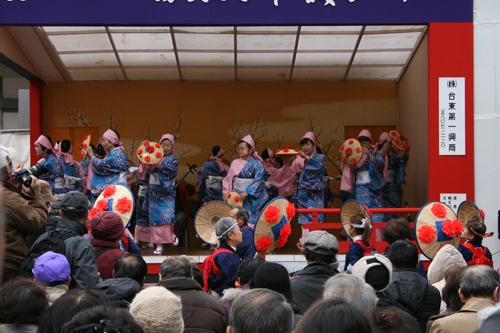
Me with Kappore dancers. Via roommate cam.
As we waited for Sakuraisan’s second performance, the tale of Nasu no Yoichi, my friends and I noticed a troupe of musicians heading past the main hall to a different part of the shrine. A few of them carried shamisen (Edo pd. guitar), so we decided to follow them. We came upon the second stage at the back of the shrine, which hosted bawdier folk dances that seemed a better match for the general atmosphere of the matsuri. Their quick, high-pitched percussion and the casual strumming of the shamisen suited celebration. I was unable to stay for the taiko (drums), but I would imagine it had a similar energy. I did see the kappore* dancers, and though I could not understand the story they narrated, I thought their dance was humorous and fun. They wore heavy makeup, and their faces were very expressive. But my favorite was the hayashyo makashyo dance. It had so much warmth and camaraderie to it. It simply looked like a group of humble, salt-of-the-earth people dancing together. I would imagine that the steady, repetitive rhythm of it would also lend itself to inebriation. Watching that dance made me want to party like a peasant. The best part was that at least half the audience clapped with the rhythm, and several elderly festival-goers rocked back and forth, murmuring the lyrics to themselves. 
Hayashyo Makashyo!
The general demographic at the matsuri reminded me of our experiences at the National Theater last week. Once again I was sad to see very few people my age. Even more so, I was surprised to find that Yuko knew almost nothing about what was happening around us. I suppose I know very little about the pastimes of my ancestors, but then a dearth of cultural heritage is one of America’s notorious flaws. Malm proposed that dying art forms are often maintained or revived by foreign cultures, perhaps because exoticism or novelty gives them value. Perhaps seeing a biwa performance in a small concert hall would be just as special in Los Angeles, but an entire matsuri is a difficult export, indispensable as it is. I only hope younger generations reach out and claim the heritage that is their birthright.


*Glossary:
Biwa - Traditional Japanese lute, first mentioned in Japanese writings of the 8th century, adapted from the chinese pipa, which is derived from the same persian prototypes as the Indian sitar and the European guitar. See my Feb. 1st entry.
Heike Monogatari - one of the world's great epics, arguably the most influential piece of literature in Japanese history. Wikipedia can do it better justice than I. However, I described it briefly in my Feb. 1st entry. http://en.wikipedia.org/wiki/Heike_monogatari
"It's a Satsuma biwa, isn't it?" - There are four prominent varieties of biwa; the satsuma biwa was developed during the Edo period (17th-19th cent.) and is known for its sweet and nuanced timbre; the name is derived from its provenance.
Dan no Ura - the decisive battle that ended the Gempei war; the climax of the tragic Heike Monogatari, described in my Feb. 1st entry.
Biwa Hoshi - Blind itinerant monks who sung narratives to the accompaniment of the biwa; most popular between the 13th and 16th centuries. Japan traditionally reserved certain professions for the blind as a kind of built-in welfare system; e.g. masseurs (zato) and musicians. The biwa hoshi formed powerful guilds and were actually utilized as a network of spies for one clan during the 15th century. Basically, they were badasses.
Miminashi Hoichi - "Hoichi the Earless," a famous biwa hoshi who found himself a little too popular with the undead. There were consequences. His story is also colorfully illustrated in the film Kwaidan. http://en.wikipedia.org/wiki/H%C5%8Dichi_the_Earless
Kami - Shinto deity. There are over 8 million in Japan; they really aren't the same as 'gods' in the Occidental sense of the term, but maybe the word 'spirit' applies? In any case, understanding the nature of the 'kami' is an important insight into even the modern history of Japan; I think Americans may grossly misunderstand the traditional "divinity" of emperors, and how that pertained to the ideology of Emperor Showa (NB: we know him as "Hirohito," but the use of that name is considered very disrespectful here--once an emperor dies his name changes). In any case, take a look if you're curious: http://en.wikipedia.org/wiki/Kami
Kappore / Hayashyo Makashyo - Your guess is as good as mine! ^_^ I believe the former is a comedic dance traditionally performed by pros while the latter is a folk dance that peasants did together at festivals? But the oft-repeated chorus was "Hayashyo Makashyo!" so it will forever be that in my mind.

Wednesday, February 9, 2011

This Just In: Photos from the Front

THIS PAST SATURDAY I SAW MOUNT FUJI FOR THE FIRST TIME EVER!!!

Again, like most sunsets, it was a lot more epic in person.


My friend Brandon was hiking with me so he took this photo. We were at the same spot in Kamakura where I saw that awesome sunset the weekend before. But the reason this sighting is so amazing is:

1) views of mount Fuji are an essential part of the Japanese experience. Viewing mount Fuji is a cultural institution that has inspired some of Japan's most famous art.

You thought I was kidding? The whole point of this, Japan's most famous woodblock, is the little mountain in the background--not the wave. It is one of a series called "The 36 Views of Mount Fuji." I guess that just wasn't enough Fuji, because he later went on to do another series called "The 100 Views of Mount Fuji." And he's not the only one.
2) It was completely unexpected. Every time I've even gotten close to a glimpse of Japan's national icon, it's been obscured by a cloudy haze; in fact, Fuji-viewing is kind of out of season, I think. So, last Saturday was no exception. But when the sun set, in a dramatic coincidence of light and fog, Fuji stood in stark silhouette against the bright red of the sunset. 'Epic' is an understatement.

Anyway, I was brimming with enthusiasm. So there it is.